

| Name | Spotify Music Quiz |
| Engine | Proprietary app/webb |
| Platform | Everything |
| Time | 3 months |
My contributions
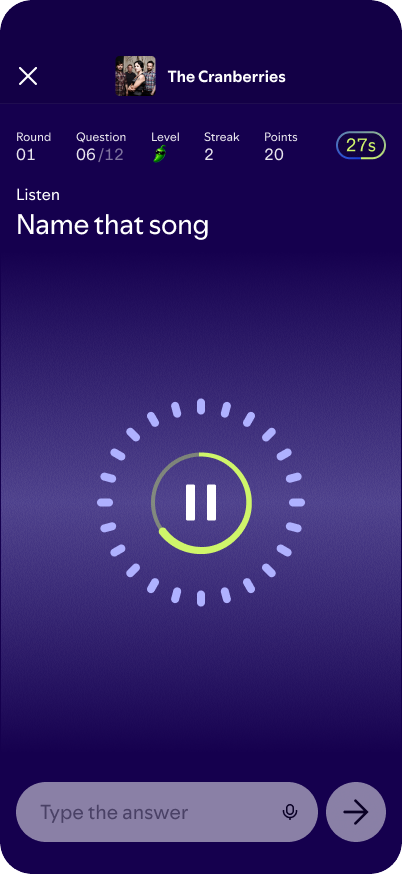
Spotify’s Music Quiz is a fast, interactive trivia game that tests music knowledge with energetic feedback, quick rounds, and a playful, Gen Z–friendly vibe.
Spotify wanted some of their 700 Million+ users to use the platform more actively, not just set it off and put in in your pocket.
The mandate was to get 10 Million active users withing the first year.
Key Challenges:
- Static interaction layer
- Weak early retention
- Lack of tooling
- Unclear long-term direction

Problem Framing
Engagement Drop-off
Early sessions didn’t sustain momentum. Strong content alone couldn’t overcome the lack of energy, tempo, and feedback.
Static Interaction
Interaction patterns felt flat and unresponsive. It behaved more like a form than an experience.
Gen Z Expectations
Competitive apps aimed at Gen Z used fast loops, expressive feedback, and rhythmic UI – our prototype didn’t match this.
Retention & Content Design
What I tackled:
-
Pacing issues slowing the game
-
Repetitive question formats
-
Weak emotional peaks
-
Missing sense of mastery
What I delivered:
-
Rebalanced difficulty curve
-
Improved pacing loops
-
New question types for variety
-
Clear, emotionally satisfying feedback

Designing Game Feel
Game feel wasn’t treated as polish – it was foundational to engagement.
I defined the “feel layer” of the product through:
-
-
-
Micro-animations on every meaningful input
-
Responsive timing tuned to a rhythmic cadence
-
Distinctive feedback sounds for correct/incorrect answers
-
Transitions that reinforced tempo and anticipation
-
-
Design Priorities:
-
-
-
Shorter loops
-
Expressive, immediate feedback
-
Strong “flow state” between questions
-
Avoiding form-like stiffness
-
Bold, playful motion cues
-
-
Internal Animation/SFX Tool
To reduce engineering bottlenecks and speed up iteration, I built an internal tool enabling designers to attach:
- Animation presets
- Audio feedback
- Transition patterns
- Timing curves
Faster experiments
Designers empowered
Higher fidelity prototypes
Less engineering friction
I also a collected, developed and curated a library of sounds for the audio profile of the Quiz.
Post-Launch Roadmap

Retention Enhancements
Daily/weekly loops, new reward structures.
New Modes
Alternative quiz formats to diversify replayability.
Social / Multiplayer
Pathways for future collaborative and competitive play.
Production & Tooling
Scaling interaction quality across future features.
Multiplayer Explorations
Each concept was designed as a complete flow: joining a session, the turn loop, feedback and reveals, what eliminated players do, and edge cases like ties, inactive users and matches that run too long.
Jam – the party mode
- Fast
- Party-style
- Up to 32 (subject to change) players
- Join a session on their own phones
- 3 rounds of 5 questions each.
- Binary scores – 1 point for correct, 0 for wrong – so the game stays clear and competitive.
Each turn follows a tight rhythm: question, silent lock-ins, an anonymous split to build suspense, then a reveal with a quick hook and instant RIGHT/WRONG feedback.
Between rounds, players get a punchy recap (grid of answers, totals, rank shifts) plus light engagement like theme voting – no rubber-banding, just fun.
Casting to a TV is optional; phones remain the controllers. Ties at the top go to a sudden-death question for a dramatic finish.
Blend – the Duel!
A duel that tests recognition and knowledge drawn from the contestants’ own listening profiles. The tone is competitive and broadcast-style: clean pacing, clear stakes, minimal flourish.
Curation & Rounds (15 total questions)
Blend seed: Create a Spotify Blend between the two contestants to surface shared and contrasting tastes.
Round plan (5 Q each):
- Round 1 – Player 1 focus (optional favorite artist): 2–3 questions centered on their top artist + 2-3 from their top genres/eras.
- Round 2 – Player 2 focus (optional favorite artist): mirrored structure.
- Round 3 – Shared focus: questions sourced from Blend overlap (artists both follow, frequently played tracks, mutual genres).
Difficulty curve: light → moderate → one “stumper” per round. Avoid repeats; enforce artist/era variety within each round.
Last Note Duel
Core premise
Players: 2
Rule: One miss = out. If one player answers wrong and the other is correct, the correct player wins immediately.
Rounds: Unlimited; each round has a small set of questions. If both survive an entire round (no misses), start a new round with higher difficulty.
Optional: use each player’s taste signals to theme early rounds (P1 focus → P2 focus → shared overlap), then escalate to mixed challenges if needed.
Per-question outcomes
- Both correct: both advance to next question.
- One wrong, one right: match ends; the correct player wins.
- Both wrong (simultaneous): wash – nobody eliminated. Immediately draw a new question (wash questions don’t count toward the round’s question count).
Finale, ties & long matches
- Primary finish: first decisive miss (while the opponent is correct) crowns the winner at any time.
- If rounds keep surviving: keep adding rounds until someone misses.
- Forced-Finale (anti-marathon): after R6 or >18 min, switch to Lightning Sudden Death: one-question rounds, 3s max answer window, faster reveals. Continue until a decisive miss.
Edge case: if several consecutive both-wrong washes happen in Lightning, keep drawing until resolved.
Last Note Standing
Here’s a clean, multiplayer elimination variant. Serious tone, crisp pacing, and plenty for eliminated players to do while they wait.
Core premise
- Players: up to 32 (TBD).
- Rule: Every question must be correct to stay in. One miss = out.
- Rounds: Unlimited. Each round is a themed set of questions.
- Survivors advance until a single winner remains (or we hit a finale mode).
Forced-Finale (match too long):
Trigger after R5 with ≥3 survivors or >20 minutes elapsed.
Switch to Sudden Death: one-question rounds; 3-second max answer window; no captions; faster reveals.
When Eliminated
You don’t leave – you switch roles:
- Ghost Mode (Play-Along, no impact)
- Keep answering to build a ghost streak; earn cosmetic badges (“All-Seeing Ear,” “Deep-Cut Guru”).
- End-of-match ghost leaderboard (separate from the winner).
- Predictor Game (Spectator meta)
- Before each survivor question, pick who you think will survive.
- Accuracy grants spectator-only badges and fuels a Hype Meter that triggers cosmetic stage effects (lights, confetti) – no gameplay impact.
- DJ Queue & Reactions
- Nominate tracks for the Post-Game Playlist (curated from match songs + spectator picks).
- Live reactions/emotes appear subtly on reveal (no hints before lock).
- Mini-Side Quizzes (timed, 10–15s)
- Micro facts about the revealed track (year, producer, chart peak).
- Cosmetic stamps only; optional “learn more” card linking to the track/artist.
AFK grace: eliminated players auto-mute in UI if inactive; they can rejoin spectator games anytime.
Outcomes
Even simple quiz mechanics become compelling when treated with the craft of action games – feel, rhythm, and expressive feedback.
Feel is Core to Retention
Tempo Shapes Emotion
Tooling Raises Quality at Scale
- Clear product direction supported by roadmap
- Improved interaction rhythm validated through playtests
- Scalable animation/audio pipeline via internal tool
- One multiplayer concept selected for future integration
What I Learned:
- Feel applies to every interface, not just games
- Designing for Gen Z requires sharper tempo awareness
- Tooling for your team is often more impactful than any single feature
- Exploring multiple concepts beats committing too early